
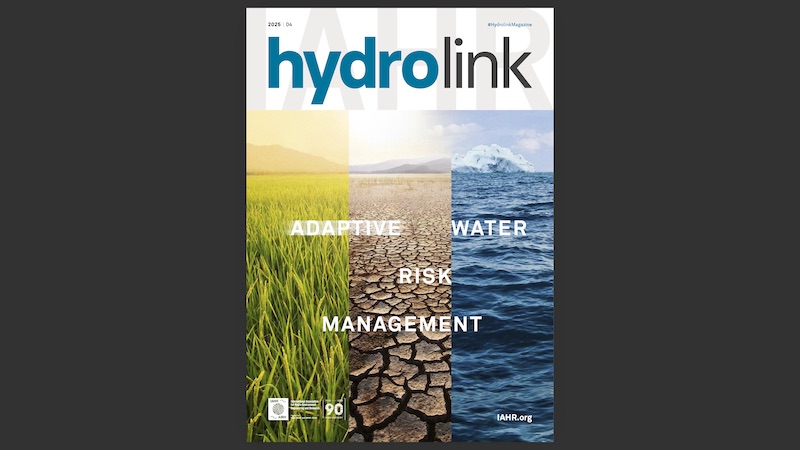
The theme of issue 2025|04 of Hydrolink magazine (IAHR quarterly) is adaptive water risk management. What is this concept? It is a shift away from thinking about water as a predictable system to an approach in which decisions are made iteratively, based on data, monitoring, modeling, and verification of the effects of actions.
This is not a new trend in management, but in the context of climate change, the distribution of risks is changing and new solutions must be sought. We are increasingly seeing extreme events that cannot be described solely by historical risk statistics (e.g., Q10, Q100). Hydrolink draws attention to what is most important for managers, designers, and society: potential effects.
This is most evident in the area of forecasting and risk analysis, especially for flash floods, where the response time is minimal and the consequences are often disproportionately large in relation to average hydrological parameters.
How does adaptive management combine science with decisions?
In the opening article of the issue, the authors remind us that adaptive management is not “flexibility” as commonly understood, but a structured process. Its meaning is that actions are treated as part of a cycle: planning → implementation → monitoring → evaluation → correction. This approach is the opposite of the current risk management system (establishing a binding plan and implementing it regardless of changing conditions). In the context of modern hydrology, it is also important to question the belief that historical hydrological conditions are a good approximation of the future. Adaptive management also means changing the way risk is communicated.
Why is a risk-based approach no longer sufficient?
Traditionally, flood forecasts have focused on physical parameters – flows, water levels, warning thresholds, etc. This approach is correct from the point of view of hydrology and hydraulics, but it has one fundamental flaw: it does not say explicitly what will happen.
The end recipient—usually an administrator, local government, emergency services, or investor—receives information such as “the water will rise to X” or “the flow will reach Y.” They then have to translate these numbers into answers themselves:
- where flooding will occur,
- which objects are at risk,
- which roads need to be closed,
- where people need to be evacuated,
- where to send equipment,
- how much the event will affect the infrastructure.
In the case of flash floods (rapid rises in small catchment areas), there is often no time for this. That is why Hydrolink shows a strong trend: a shift from forecasting water parameters to forecasting the effects of the event.
What is impact-based forecasting and why is it groundbreaking?
Impact-based forecasting means that the goal of the system is not only to answer the question “how high will the water be,” but “what will the consequences be.”
This means that the forecast should include information such as:
- which sections of the valley will be flooded,
- how deep and fast the flow will be in the area,
- which infrastructure facilities are in the impact zone,
- what the losses and disruptions may be,
- what the priority of protective measures is.
This changes the way decisions are made, as it allows for faster and more effective action. Instead of analyzing dozens of hydrograph charts, the recipient sees a map and a message: “the effects will be here, action must be taken here”.
Flash floods are the new normal
In 2024 and 2025, Poland experienced a series of flash floods, e.g., in September 2024 in the Odra river basin and in July 2025 in Małopolska and Silesia, among others.
Flash floods are among the most difficult challenges for warning systems, as Hydrolink strongly emphasizes. This is mainly due to their extreme spatial variability, as intense rainfall can persist over a single, small catchment area, while neighboring areas remain almost dry.
Such events develop very quickly and usually involve small watercourses or networks of tributaries, which further complicates the description of the phenomenon. Hydrometeorological monitoring is sometimes insufficient, and models are difficult to calibrate well because there is a lack of data from specific episodes. As a result, the actual consequences of flash floods can be greater than the flow analysis alone would suggest. This is why impact-based forecasting is particularly valuable in this area.
How to build a flash flood impact forecasting system – a case study from France
The authors describe their experiences with the “Vigicrues Flash” system, which has been operational since 2017 and automatically warns of the risk of sudden floods. At the same time, they emphasize that in its current form, the system needs further improvement—it does not provide sufficient lead time and does not give detailed information about the extent of the flood and its effects.
The research is developing an impact forecasting chain that combines:
- precipitation information (including radar precipitation estimates),
- a hydrological model (flows in the watercourse network),
- a library of hydraulic scenarios (previously calculated flood maps),
- an impact layer (comparison with data on actual damage).
The pragmatic approach described here is important: instead of calculating the full hydraulics “from scratch” in real time for the entire region, the system relies on pre-prepared scenarios to select the best option for the expected intensity of the event in the operational forecast.
Adaptive water risk management and HydroBIM practice
It is worth adding that this approach corresponds well with how we work at HydroBIM. Adaptive water risk management involves an iterative process: hypothesis testing, modeling, implementation of measures, monitoring, and adjustments as new data or changes in conditions arise.
In linear infrastructure projects, this is exactly what the sensible use of hydrological and hydraulic models looks like. These are tools for variant solutions, identifying critical locations, assessing impacts in the field, and consciously managing uncertainty (including climate uncertainty). Risk analysis does not end with flow parameters, but leads to specific design decisions and recommendations to limit the consequences of extreme events.
The full text of Hydrolink issue 4/2025 is available for free download from the IAHR website.
International Association for Hydro-Environment Engineering and Research (IAHR)
IAHR is the International Association for Hydro-Environment Engineering and Research, founded in 1935 as an independent, global non-profit organization bringing together scientists and engineers.
It promotes research and practical applications in fields such as river and marine hydraulics, water resource management, eco-hydraulics, hydroinformatics, and disaster prevention by organizing congresses, publishing journals, and collaborating with UNESCO and the WMO.
About HydroBIM

HydroBIM sp. z o.o. is a specialized subcontractor in the hydrotechnical and hydrological industry for large infrastructure projects. Our clients include leading Polish and international design offices and consulting companies, such as AECOM, Sweco, EGIS, and Systra.
Our portfolio includes tasks within the Flood Protection Project in the Odra and Vistula River Basins (POPDOW) and the Central Communication Port (CPK).
We are a member of the Polish Association of Designers and Engineers (ZOPI).
We invite you to follow the company profile of HydroBIM on LinkedIn.
Source of main image: cover page of the described issue of HydroLINK