
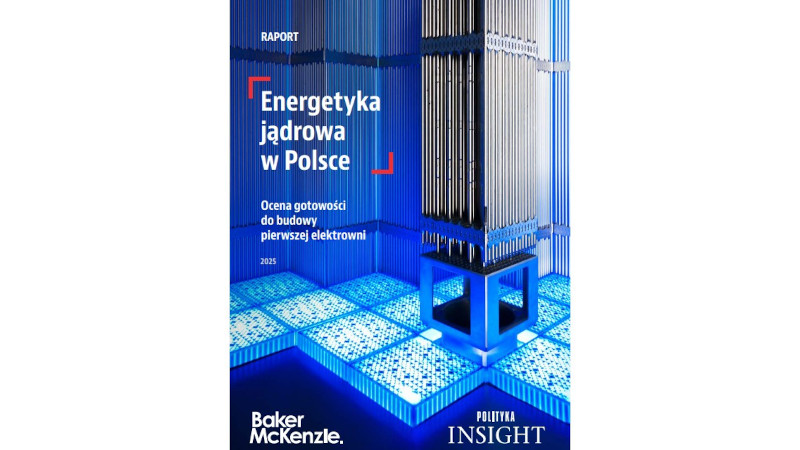
Nuclear energy in Poland is entering a decision-making phase. The year 2025 will be a test for the government and the investor PEJ. We analyse the report by Baker McKenzie & Polityka Insight, which measures the readiness of this project using the Nuclear Readiness Index.
The publication focuses on the Lubiatowo-Kopalino project. The authors show that although the political environment has changed since the 2023 elections, nuclear power remains a priority. The report is based on public sources, investor data and expert interviews.
Nuclear Readiness Index – are we ready for Polish nuclear power?
The authors of the report have proposed a weighted system. A scale of 0-10 describes each of the six pillars. The weights reflect the importance of each element in the overall assessment. The following weights were adopted:
- System and Investments 20%,
- Regulations, Policy, Society, Technology 15%.
The assessment is based on milestones. The synthetic indicator is the weighted average of the partial results.

Results of the report Nuclear Energy in Poland 2025
The strongest pillars are political and regulatory readiness. The authors highlight the set of special laws and compliance with IAEA guidelines. According to the authors of the report, our technological preparedness is the weakest, with a score of only 3/10. Here is a detailed discussion of the pillars of nuclear energy in Poland, according to Baker McKenzie & Polityka Insight:
- Regulations – 8/10. The Sejm adopted an amendment to the special nuclear law in February 2025. The act allows for direct recapitalisation of the PEJ company and introduces provisions on CFD financing. The National Atomic Energy Agency has a clear licensing path for large units and SMRs.
- Policy – 9/10. The government coalition maintains cross-party support for the nuclear programme. The PEP 2040+ energy strategy provides for three locations for large power plants and a number of SMR projects. However, there is no statutory definition of the ownership model for the transmission system operator for modular reactors.
- System – 4/10. PSE plans new 400 kV lines from Pomerania to the centre of the country. The schedule is synchronised with the launch of EJ1, but energy storage facilities and power reserves are still at the concept stage. Integration with the day-ahead market requires the adaptation of algorithms to the operation of 1,150 MW units.
- Investments – 4/10. The estimated budget for EJ1 is PLN 192 billion. The State Treasury covers PLN 60.2 billion of the capital, export agencies declare PLN ≈ 95 billion in loans, and the gap is still estimated at several dozen billion PLN. The European Commission is conducting an investigation into the legality of state aid.
- Society – 8/10. The report notes record support for nuclear energy in Poland. More than two-thirds of respondents approve of the construction of reactors, although local protests against the expansion of the protection zone around the construction site continue in the municipality of Choczewo.
- Technology – 3/10. The supply chain is still taking shape. Domestic companies have experience in energy construction, but not in the assembly of AP1000 reactors. Westinghouse is conducting audits of potential subcontractors for steel modules and precast concrete elements, but certification will take several years.
In summary, the report assesses Poland’s readiness to build its first nuclear power plant at 58%, which, in our opinion, indicates a low level of preparedness.
What are the most significant problems? Nuclear supervision staff and resources are insufficient. Supporting infrastructure, such as roads and 400 kV transmission lines, needs to be modernised or built.
The role of nuclear energy has not been linked to the plan to modernise the National Energy System.
The report highlights the lack of decisions on the scale and technology of reactors for subsequent projects.
The index is to be updated annually.
Current status of the EJ1 project (Lubiatowo-Kopalino)
PEJ obtained an environmental decision in 2023. The location on the Baltic Sea is maintained.
In September 2024, the government applied for approval of state aid from the EC in Brussels. On 18 December 2024, the EC initiated formal proceedings covering three instruments: capital, State Treasury guarantees for 100% of the debt and a 60-year difference contract. The EC’s decision is expected at the end of 2025. A more likely date is 2026. The signing of the EPC contract with Westinghouse/Bechtel is planned for early 2027, with the pouring of the first concrete in 2028 and the commercial start-up of unit 1 in 2035.
Although the EC’s decision is fundamental to the entire project, work has already begun. Geotechnical surveys for the turbine foundations are underway at the construction site. At the same time, port facilities are being built in the Port of Gdynia to handle heavy reactor cargo.
Polish construction companies have high hopes for the project, counting on the government’s declarations that at least 50% of the investment budget will be spent on ‘local content’.
Other large power plant and SMR projects
Nuclear energy in Poland is not limited to the Lubiatowo project. The process of selecting the location and technology for EJ2 remains open. The Prime Minister has announced a competitive dialogue with Westinghouse, EDF and KHNP. The government is also considering the participation of end users in the shareholding structure, which is expected to reduce capital costs.
Another concept is EJ Pątnów. The consortium of ZE PAK, PGE and KHNP is still working on a feasibility study for APR1400 reactors. The report indicates that there has been no regulatory breakthrough in the last 18 months.
Small modular reactors (SMRs) are another programme led by Orlen Synthos Green Energy. The PAA issued a general safety opinion for the BWRX-300 in May 2023. The GDOŚ is conducting environmental proceedings for the Stawy Monowskie, Włocławek and Ostrołęka sites. In December 2023, OSGE obtained six fundamental decisions covering 24 reactors in six cities.
KGHM is cooperating with NuScale on the VOYGR-6 project in Żurawica. Tauron is analysing the Canadian SMR X-energy for industrial heat cogeneration.
On paper, it looks very promising. However, a major risk for SMR projects is that they compete for the same human resources.
Barriers to the development of nuclear energy in Poland
Exactly – the shortage of engineering personnel is a major problem. And not only in the nuclear energy sector. There is a shortage of hydraulic engineers, geologists and many other specialists. The report gives a score of only 4/10 for human resource readiness. Turnover in PEJ and other companies is high, and technical universities are closing courses rather than launching new ones.
There is no supply chain. Access to nuclear fuel still depends on agreements with the technology supplier.
The financial model currently has no guarantee of public support. The European Commission prefers a pure contract for difference, while the authors propose allowing mixed instruments to reduce the cost of capital.
Regulatory risk is growing because this is the first such project to be implemented in Poland. Rapid amendments will be needed when gaps in the law appear. The problem of lengthy administrative procedures, which has plagued infrastructure investments in recent years, may also become apparent.
Public acceptance requires ongoing information campaigns. At present, there seems to be no uniform plan for promoting nuclear energy, which increases the risk of protests.
What conclusions can be drawn from the HydroBIM report?
Nuclear energy in Poland is entering the implementation phase. As with other infrastructure investments, the role of hydrotechnology, although not primary, is extremely important. Hydrotechnical design in nuclear projects is not limited to cooling systems. It includes construction site drainage, hydraulic and hydrodynamic models, and rainwater impact analyses. HydroBIM provides these competencies. Our team works efficiently in both Autodesk and Bentley BIM environments. Completed contracts for infrastructure investors show that we successfully integrate environmental, geotechnical and structural data into a single CDE environment. By including HydroBIM in nuclear consortia, investors gain proven know-how, BIM Level 2 processes and scalable design resources in hydrotechnology – an important prerequisite for success when nuclear energy in Poland accelerates.
Feel free to contact us for consultation!
Source of illustrations: bakermckenzie.com
The full text of the report Nuclear Energy in Poland 2025 is available for free download at bakermckenzie.com.