
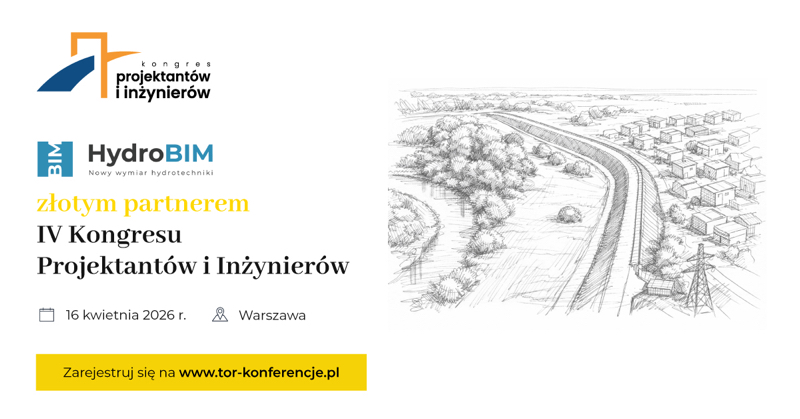
The Congress of Designers and Engineers, organised under the auspices of ZOPI, will hold its fourth edition in 2026. Previous events have received very good reviews from the industry and the community, which is why we hope that the Congress will become a permanent fixture in the calendar.
What particularly concerned us at HydroBIM was the lack of topics related to hydrotechnology in previous editions – as if this industry did not exist at all!
The importance of hydrotechnology in infrastructure design
In modern infrastructure projects, hydrotechnology is one of the elements that determine whether an investment will be safe and durable. This applies to linear infrastructure, environmental investments and cubature facilities.
Solutions designed by the hydrotechnology industry influence the geometry of facilities, their foundations and the way the land is developed. They determine how the investment responds to rainwater, floods and changing hydraulic conditions. These issues are important and cannot be overlooked or simplified at the concept stage, because the consequences of wrong decisions come back later in the form of costly corrections.
Climate change only exacerbates this problem. Phenomena that were considered extreme not so long ago are now becoming part of the design scenario.
Investments are accelerating and there are fewer and fewer hydrotechnical engineers
The government has announced another investment offensive in infrastructure. The scale of the planned projects is impressive, but with it come growing demands on the design teams. At the same time, the market is increasingly feeling the lack of hydraulic engineers.
The problem is not only about the number of specialists. There is a particularly noticeable shortage of people who are proficient in the use of digital tools. The CPK project has given a clear impetus – the implementation of BIM in infrastructure projects is becoming standard. PKP PLK is taking the implementation of BIM seriously, with a nuclear power plant and military and dual-use infrastructure projects on the horizon. Are the digital skills of modern hydraulic engineers keeping pace?
Digital tools are changing the work of hydraulic engineers
Modern hydraulic engineering is based on hydraulic and hydrological models. Without them, it is difficult today to analyse variants, assess risks and predict the effects of design decisions. BIM, GIS, data integration and specialised software are becoming the basis of a hydraulic engineer’s work.
This requires new skills. It is no longer possible to ‘calculate on the cheap’; data must be prepared and integrated into a multi-disciplinary model. And this is often beyond the scope of the traditional approach to design.
The design market is already operating in this reality. Is the education system also?
Universities without students, projects without specialists?
We hear, that more and more universities are limiting or closing hydrotechnical courses. The reason is a lack of candidates. For young people, this career path can be unclear and unprestigious.
This is another paradox. The demand for hydrotechnical skills is growing, while at the same time the number of people who decide to acquire them is decreasing.
Who will manage the infrastructure? PGW Wody Polskie already has staffing problems. We at HydroBIM have no reason to complain, because we decided to use BIM back in 2019 and now have extensive experience and practical skills in using modern technologies. However, the demand for hydrotechnicians proficient in BIM methodology already exceeds our company’s capabilities – we have to turn down some orders.
And if this trend continues, the problem of staff shortages will become one of the main constraints on the development of infrastructure projects.
That is why we want to rebuild the prestige of the profession of hydraulic engineer and break away from the unfair label of concreting rivers.
Debate as a starting point for discussion on the future of modern hydrotechnology
We do not look to others and actively work for hydrotechnology within the structures of ZOPI. During the 4th Congress of Designers and Engineers, we will lead a debate on hydrotechnology.
We will address the above and other issues because, however it may sound, it is difficult to imagine modern and safe infrastructure without modern hydrotechnology.
That is why it is worth being in the debate room. We invite you on 16 April 2026 at 2 p.m.
About HydroBIM

HydroBIM sp. z o.o. (Ltd) is a design office specialising in hydrotechnology and hydrology in large infrastructure projects. Our clients include leading Polish and international design offices and consulting companies, such as AECOM, Sweco, EGIS and Systra.
Our portfolio includes tasks within the Flood Protection Project in the Odra and Vistula River Basins (POPDOW) and the Central Communication Port (CPK).
We are a member of the Polish Association of Designers and Engineers (ZOPI).
We invite you to follow the company profile of HydroBIM on LinkedIn
Our portfolio includes tasks within the Flood Protection Project in the Odra and Vistula River Basins (POPDOW) and the Central Communication Port (CPK).
We are a member of the Polish Association of Designers and Engineers (ZOPI).
We invite you to follow the company profile of HydroBIM on LinkedIn and to work with us.