
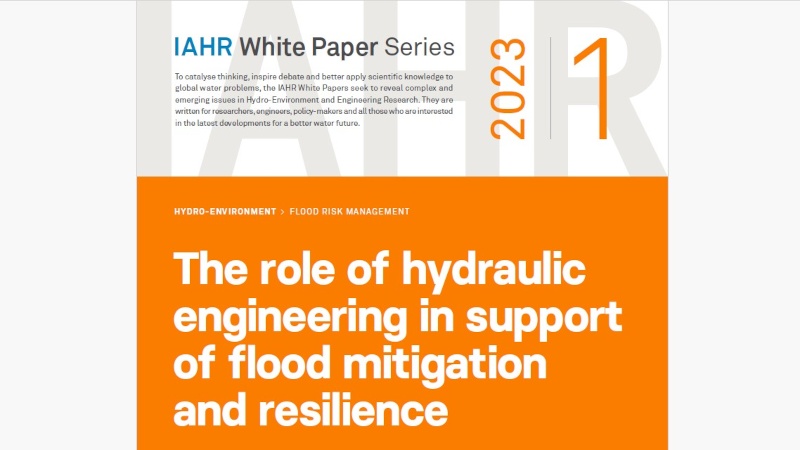
In 2023, the International Association for Hydraulic and Environmental Engineering (IAHR) published a white paper entitled ‘The Role of Hydraulic Engineering in Support of Flood Mitigation and Resilience’.
IAHR is a global organisation of engineers and scientists from over 70 countries specializing in hydraulics, hydrology and environmental engineering.
The publication is the result of work by experts from Europe, Asia and America who have gathered experience from large flood control projects.
It describes tools, methods and working standards to increase the effectiveness of flood protection.
Many of these recommendations overlap with what we do at HydroBIM – from detailed hydraulic and hydrodynamic analyses to the integration of BIM models with GIS data.
This proves that our work complies with international standards and the real needs of modern design in the hydro-technical industry.
Trends in flood control engineering according to IAHR
Design based on ‘constant’ hydrological parameters is increasingly failing.
Events overlap, e.g. high river levels coincide with heavy rainfall. Such a combination – known as complex events – increases losses and makes it difficult to select the appropriate parameters for structures. The IAHR points out that this is now a realistic scenario rather than an exception.
Short, intense rainfall causes rapid surface runoff and sewer overload. Models of urban drainage subsystems provide measurable value: they help identify critical nodes, select distributed retention and conduct discussions with network managers based on figures. The IAHR cites studies showing that such modelling improves investment decisions and reduces operating costs.
River monitoring is not easy, even with a dense network of water gauges. The state-flow relationship changes over time, especially during sudden floods. This affects the quality of short-term forecasts. The IAHR recommends measurement methods that take this hysteresis into account.
Water resource management is no longer divided into ‘floods’ and ‘droughts’. These processes interact, and investments must combine flood retention objectives with water balance objectives during periods of deficit. The report encourages the combination of analyses and indicators in a single set of tools and a single decision-making process.
The project team must have access to a common model and common data. Separate files and parallel versions lead to discrepancies between hydraulics, roads, bridges and geotechnics. The report promotes an integrated approach by combining flow models with spatial information and the documentation life cycle. This shortens iterations and facilitates the agreement of solutions with the client.
Modern tools and technologies recommended by IAHR
The IAHR report points to the growing role of numerical models across the full spectrum of dimensions – from 1D to 3D – selected according to the scale and complexity of the problem.
1D models work well for analysing long sections of rivers or canals, where rapid calculation of hydrographs and water levels is crucial.
2D models are preferred when information on velocity and depth distribution in the terrain is needed, e.g. in floodplains, river valleys and estuaries.
3D models are used where the flow is strongly three-dimensional: in areas of bridges, locks, at the mouths of tributaries with a steep gradient, or in the vicinity of hydrotechnical structures with complex geometry.
The report emphasises that today’s increasing computing power allows 2D and 3D simulations to be carried out with high spatial and temporal resolution. Input data can come from LIDAR measurements, photogrammetric scanning from drones, precipitation radars or satellites. Combined with data assimilation during the simulation, this makes it possible to perform calculations in near real time.
The integration of hydraulic models with GIS systems is becoming increasingly important. This ensures that geometry and boundary conditions are continuously synchronized with topographical data, development plans and the location of existing infrastructure. A change in one data source automatically updates the model and analysis results.
The IAHR also describes examples of the use of artificial intelligence in the modelling process. Machine learning algorithms support calibration, result analysis and the creation of simplified models that allow a larger number of scenarios to be tested in a shorter time.
The report indicates that the next step is to link the results of 1D/2D/3D models to the BIM model of the entire facility or hydrotechnical system. Automatic transfer of calculation results to the design model allows different industries to work on the same set of data and minimises the risk of inconsistencies in documentation.
It is precisely this way of working – selecting a model to suit the scale of the problem, integration with GIS, high data resolution, automation of results transfer to BIM – that forms the basis of the HydroBIM methodology for projects carried out by large design offices.
Interdisciplinary cooperation and stakeholders – IAHR conclusions
The IAHR report clearly states that effective flood protection projects require coordination between multiple entities – not just the investor and the design office. Water managers, infrastructure operators, local government units and emergency services are all involved. The lack of a common language between these groups leads to delays, design changes and additional costs.
One of the key recommendations is to introduce a common database and working model accessible to all participants in the process. The idea is that the hydraulic engineer, bridge designer, urban planner and representative of the contracting authority should all see the same boundary conditions, the same flood scenarios and the same simulation results. The integration of BIM with hydraulic models and GIS is a tool that the report identifies as particularly effective.
This is exactly how we work as a subcontractor in the hydrotechnical industry on CPK railway projects, using tools such as Bentley ProjectWise.
The report also emphasises the importance of transparent presentation of results. Instead of sending spreadsheets with numbers, it is better to prepare interactive flood maps, flow animations or cross-sections with design variants marked. These forms are easier to understand for people outside the hydrotechnical industry, and decisions can be made faster.
This philosophy translates into better efficiency. If a subcontractor – such as HydroBIM – can deliver models and visualisations ready to be integrated into the general designer’s working environment, this eliminates the need for additional data processing. This significantly reduces the time needed to complete the design phase and allows the client to stay on schedule despite cost and time pressures.
Why is it worth working with HydroBIM?
HydroBIM operates as a specialised subcontractor in the hydrotechnical industry. Our client is a large design office that needs to deliver complete documentation on time, often under tender pressure or design changes. In this role, speed, precision and compatibility with the client’s processes are key.
- Precise analyses – we use advanced hydraulic and hydrodynamic models in 1D, 2D and 3D, in accordance with IAHR recommendations. This means that the customer receives results that take into account real flow conditions, are well calibrated and ready to be defended before the investor or administrative body.
- BIM and GIS integration in a single data flow – our studies can be directly incorporated into the customer’s BIM model, maintaining the link to spatial data. This allows bridge, road and geotechnical designers to see the latest analysis results in their working environment without having to make manual corrections.
- Optimisation of design solutions – we prepare alternative scenario analyses that show the impact of design or organisational changes on hydraulic conditions. The client can choose the solution that optimises costs, safety and contract requirements.
- Minimisation of contractual risk – documentation based on hard data and simulations reduces the risk of disputes with the client. If the accepted solution is questioned, the model and its results become a strong argument.
- Increased customer competitiveness – by commissioning HydroBIM analyses, the design office can offer the investor a full range of services without the need to maintain its own team of hydrotechnicians. This is important, especially now, when there is a shortage of experienced hydrotechnicians proficient in the use of modern technologies.
HydroBIM’s offer in light of the IAHR recommendations
The IAHR white paper shows that the direction of development of the flood protection industry is clear: greater precision in modelling, better data integration, flexible response to changing conditions and transparent presentation of results. These are elements that have been the foundation of our work for years.
As a subcontractor for large design offices in Poland and companies operating globally, HydroBIM provides exactly the solutions that IAHR recognises as the standard of the future. We combine hydraulic and hydrodynamic analyses with BIM and GIS integration, providing data ready to be integrated into the customer’s working environment.
As a result, cooperation with HydroBIM means the ability to implement projects in accordance with international standards – without the need to build your own expensive hydrotechnical infrastructure.
The value is simple: less risk, more certainty and readiness to win contracts in a demanding infrastructure market.
Contact HydroBIM!
The full text of the report is available for download on the IAHR website
Cover image: excerpt from the title page of the report.
About HydroBIM:
HydroBIM sp. z o.o. is a design office specialising in hydrotechnical and hydrological subcontracting for large infrastructure projects. Our clients include leading Polish and international design offices and consulting companies, such as AECOM, Sweco, EGIS and Systra.
Our portfolio includes tasks within the Flood Protection Project in the Odra and Vistula River Basin (POPDOW) and the Central Communication Port (CPK).
We are a member of the Polish Association of Designers and Engineers (ZOPI).
We invite you to follow the HydroBIM company profile on LinkedIn and to work with us.